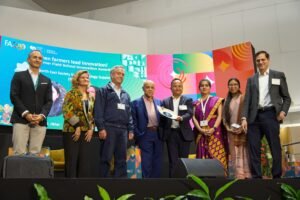
Rome, May 28, 2026: The North East Society for Agroecology Support (NESFAS) was invited by the International Fund for Agricultural Development (IFAD), Rome, through the Indigenous Peoples Assistance Facility (IPAF), to present its present work on improving children’s health through school meals that incorporate indigenous foods at the global stage.
The initiative was showcased during the Rome Nutrition Week, held from May 25-28, 2026, at the headquarters of the Food and Agriculture Organization (FAO) in Rome.
NESFAS was represented by Mr. Pius Ranee, Executive Director and Mr. Phrang Roy, Founding Chairperson of NESFAS.
It may be recalled that in 2015, NESFAS brought the Global Gathering Indigenous Terra Madre (ITM) at Shillong and Mawphlang, Meghalaya. Leading to the event, NESFAS had undertaken an extensive research on food and nutrition in collaboration with McGill University, Canada and the National Institute of Nutrition, Hyderabad.
Through this study, it was found that despite the abundance of natural resources and biodiversity, nearly 31% of school children were undernourished, while 57% were underweight, reflecting significant nutritional imbalances among children. Based on these findings, NESFAS has been working closely with local communities, especially parents and teachers, to integrate locally sourced local foods into school mid-day meals. This work has been strengthened through collaboration with various stakeholders and by utilizing tools such as the IFAD Digital Toolbox and the ten food groups model developed by FAO.
The initiative was first piloted in 2022 in 11 schools, supported by funding from The Indigenous Partnership for Agrobiodiversity and Food Sovereignty (TIP), Rome. Today, it has expanded to 26 schools, benefiting over 2,000 children, who now have access to healthier and more nutritious meals.
Speaking during the Rome Nutrition Week event, Mr. Pius Ranee highlighted that the initiative’s success has been driven by the collective efforts of parents, teachers, communities, and particularly local farmers. He noted that farmers have gained market opportunities by supplying local foods to schools. An important part of this model is the integration of wild edibles, especially green leafy, into the meals.
He further emphasized that one of the most encouraging aspects of the initiative is the active contribution of parents, who voluntarily donate produce from their own kitchen gardens for the benefit of both their children and the wider school community. To further strengthen the initiative, NESFAS has also conducted nutritional analyses of wild edible plants, which revealed significant nutritional properties capable of improving health outcomes, particularly in addressing anaemia.
In his concluding remarks, Mr. Ranee expressed NESFAS’ aspiration to scale up this initiative across the entire state through stronger collaboration with communities, various government departments, and like-minded organizations committed to improving children’s health and nutrition.
The session was chaired by H.E. Elissa A. Golberg, Ambassador and Permanent Representative of Canada to the Rome-based United Nations Food and Agriculture Agencies.