Written by Dahunika Rymbai
Kong Raphida Nongrum’s journey is inseparable from the land she cultivates and the community she serves. A farmer and Community Facilitator from Itsohpair village in Ri-Bhoi district, her work reflects the strength of consistency, the wisdom of traditional knowledge, and the quiet determination required to bring lasting change at the grassroots level. Her story is not one of instant success, but of gradual transformation shaped by years of learning, practice, and trust-building.
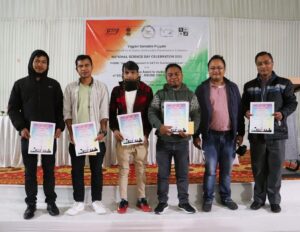
In 2023, she was honoured as the Best Community Facilitator (CF) in the Ri-Bhoi Cluster where NESFAS is actively working. In the same year, the Itsohpair Agroecology Learning Circle (ALC) also received recognition for its collective efforts and strong performance. These recognitions marked an important milestone, not only for her individual contribution, but also for the wider community that had been steadily working together to adopt agroecological practices.
Her role as a Community Facilitator grew through continuous engagement with NESFAS programmes. Training, workshops, exposure visits, and meetings organised by NESFAS, partner organisations, and government departments became important spaces for learning and exchange. She approached these opportunities with seriousness and curiosity, understanding that meaningful change in farming requires both knowledge and adaptation. What she learned through these platforms was carefully applied to her own farm and shared with others through demonstrations and discussions.
Now, as an active member of the Itsohpair Primary Agroecology Cooperative Society, Kong Raphida has dedicated herself to practising and promoting organic farming. Her vision extends beyond individual success. She believes in building a sustainable system where organic produce flows directly from farms to consumers, ensuring fair returns for farmers while improving access to healthy, chemical-free food.
Her approach to farming is firmly rooted in natural processes. Soil fertility on her land is maintained using animal waste, plant residues, forest biomass, and compost prepared on the farm. Chemical fertilisers and pesticides are avoided, not out of convenience, but through a conscious commitment to restoring soil health and ecological balance. By relying on locally available resources, she reduces dependency on external inputs and strengthens the long-term productivity of the land.
Ecological pest management forms an important part of her practice. Rather than seeking immediate solutions, she encourages methods that work gradually by improving crop diversity and soil vitality. Farmers in the village often turn to her for guidance on composting techniques, natural pest-control methods, and mixed cropping systems.
Traditional agricultural knowledge remains central to her work. Instead of replacing inherited practices, she builds upon them by integrating new learnings from agroecology programmes. This balance between tradition and innovation makes her approach accessible to farmers who may initially be hesitant to adopt new methods.
Her kitchen garden stands as a living example of biodiversity and food security. Within a relatively small space, a wide variety of crops grow together, including taro, tubers, vegetables, fruits, and rice. This diversity ensures year-round food availability for her household while also demonstrating the benefits of mixed cropping systems to other farmers.
Beyond daily cultivation, Kong Raphida has made significant contributions to seed conservation and crop revival. One of her most important initiatives has been the revival of finger millet, a traditional crop that had almost disappeared from Itsohpair. Once an integral part of local diets and farming systems, finger millet gradually declined due to changing food preferences, reduced cultivation, and the increasing dominance of commercial crops.
Today, finger millet is once again present in the village’s fields. Plans are underway to collectively market the produce next year as part of the cooperative’s livelihood initiative. This effort is not only about income generation, but also about restoring traditional food systems, improving nutrition, and strengthening seed sovereignty within the community.
Under her leadership, the Itsohpair Primary Agroecology Cooperative Society supplies fresh vegetables to the Community-led School Meals Programme. This initiative ensures that children receive nutritious, locally grown food while farmers benefit from a stable and reliable market. It reinforces the idea that local food systems can support both livelihoods and community health.
In addition, she has supported ten farmers in transitioning from chemical-based farming to organic practices. For many of these farmers, the shift was challenging. Years of dependence on chemical inputs had created fears of reduced yields and uncertainty about alternative methods. The transition required patience, regular follow-ups, and repeated demonstrations over multiple cropping seasons. Compost preparation, use of bio-pesticides, and gradual reduction of chemical inputs formed the foundation of this change.
Her journey as a Community Facilitator has not been without challenges. While the community is largely supportive, a small percentage of farmers remain hesitant to move away from chemical-based farming. Convincing them required sustained effort, personal engagement, and trust-building. Change did not happen quickly, and progress was often incremental.
Balancing responsibilities has been another ongoing challenge. Managing her own farm, fulfilling her duties in the cooperative society, caring for her family, and leading community initiatives demand strong commitment and careful time management. Agricultural seasons often bring long working hours, leaving little room for rest. Yet, she continues to fulfil these roles with determination.
Climate uncertainty has further complicated her work. Irregular rainfall, shifting seasons, and extreme weather events make farming increasingly unpredictable. These conditions make it difficult to demonstrate immediate results of organic practices, especially to new adopters. Despite this, she continues to emphasise soil health, biodiversity, and local resource use as key strategies for long-term resilience.
Her leadership style is grounded in patience and consistency. And today, her influence extends beyond Itsohpair village. Farmers from neighbouring communities visit to observe agroecological practices, exchange seeds, and learn from her experiences. Through these interactions, knowledge travels informally, strengthening agroecology networks across the region.
Kong Raphida Nongrum’s story demonstrates how meaningful transformation often begins quietly, guided by individuals who are deeply connected to their land and community. Her work contributes to ecological sustainability, strengthens community institutions, and helps revive traditional agricultural knowledge. It reflects a form of leadership rooted in care for the soil, for people, and for future generations.
In a time when agriculture is increasingly driven by quick solutions and external inputs, her journey stands as a reminder that sustainable change grows slowly. Like seeds planted with intention, it requires patience, trust, and collective effort. Through her continued commitment, the fields of Itsohpair are not only producing food, but also cultivating resilience, dignity, and hope.