Indigenous Communities of East Khasi Hills take the lead in restoring barren and degraded land through the help of NESFAS
A report on The Global Threat of Drying Lands by the United Nations in 2024 highlighted that 40% of the world’s land is degraded. For many indigenous communities who are custodians of the majority of biodiversity globally, rapid industrialization and other factors have led to their lands being degraded, pushing them further towards loss of livelihoods and food insecurity.
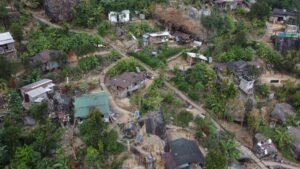
From 2021-23, NESFAS, and the Food and Agriculture Organisation (FAO) Rome, collaborated in a pilot initiative for the implementation of Indigenous Peoples’ Biocentric Restoration Project in 5 villages. The project identified an area of 536 hectares of barren and degraded land for restoration in East Khasi Hills. Over the past years NESFAS has played a crucial role in successfully restoring 14 hectares of barren and degraded land through a community-led initiative of planting local plant species.
However, with over 522 hectares of barren and degraded land still in the five villages, it remained pertinent to have an initiative that would work towards restoration of the health of the soil and the biodiversity of these barren lands and safeguarding the livelihoods of indigenous communities in these lands.
To address this, NESFAS, in 2024 launched the project “Demonstrate successful community led management plan of degraded lands to conserve and manage wild biodiversity and Agrobiodiversity for local livelihoods security” under OP-7 of the GEF Small Grants Programme in India (SGP India) funded by the United Nations Development Programme.
The project which kick started in January 2024 will run till December 2026 and is being implemented in 5 villages in East Khasi Hills Meghalaya, viz. Nongtraw, Dewlieh, Umsawwar, Ladmawphlang, and Nongwah. One of the main objectives of the project is to restore 200 hectares of degraded community land and link forest patches through reforestation efforts. Additionally, 50 hectares will also be brought under improved practices with focus on soil health.
Since the project’s implementation, general awareness and signing of the Free Prior and Informed Consent (FPIC), and GIS mapping of the restoration sites have been carried out in the five partner communities. NESFAS has also collaborated with technical institutions like Indian Center of Agriculture Research (ICAR) and Meghalaya Bioresource Development Agency for soil testing.
To fast-track the restoration process, each of the five partner communities have developed a prioritized list of 15-20 local tree species to plant in the restoration process. The plant species have been identified drawing on traditional knowledge of the communities with special emphasis on how these tree species help in supporting soil health, water regulation, and pollination.
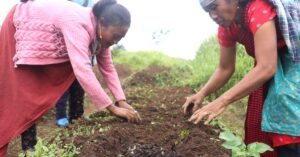
With this emphasis on planting local tree species, the partner communities have also taken ownership of the responsibility of nurturing the 2,00,000 saplings required to cover the target 200 hectares of barren and degraded land. Since the start of the project, 50 farmers from the communities have raised 50,000 saplings and technical training is currently in place to set up household nurseries in order to raise the remaining 1,50,000 saplings.
“We need to strategize our management approach on nurseries and most importantly, set a clear target for ourselves to determine whether we can achieve it,” shared Kristina Rani, a farmer from Nongwah in one of the training sessions for setting up household nurseries.
Along with the regeneration of the barren and degraded lands, NESFAS has identified 30 plant species and wild edibles rich in micronutrients and resilient to climate change which will be planted in an area of 50 hectares under improved practices. Here, farmers will be given technical support to scale up best practices encompassing efficient land use, seed selection, soil management and pest control strategies, tailored to suit the local environment and agricultural context.
The project’s objectives don’t end with just the regeneration of degraded lands but also strive to integrate livelihood activities for the communities along with the regeneration process. As such, the project also seeks to strengthen capacity building to demonstrate successful community-based initiatives to conserve and manage wild biodiversity and agrobiodiversity for local livelihood security.
However, it is worth mentioning that some other livelihood activities running concurrent with the current project are not funded by the SGP. One such activity is the capacity-building initiative for school teachers and parents that links wild biodiversity and agrobiodiversity to School Meal programme – where NESFAS has built on the Government’s PM Poshan Meals initiative and helped increase school children’s access to healthy, nutritious, and diverse balanced diet through a community-led approach.
Another such activity is the mapping of 250 homestead gardens and farms aimed at supporting farmers to diversify their production system with the identified species to enhance diversity, resilience and consumption through the domestication of wild biodiversity into their existing homestead gardens and farms.
Besides the above interventions, the project will also expand the idea of Mother Earth Cafe (locally known as Mei-Ramew Cafe) which has been successfully implemented in other districts of Meghalaya. i.e Ri Bhoi and West Garo Hills.
The partner communities have taken it upon themselves to execute and carry out the project successfully with Pynjanai Sawkmie from Ladmawphlang stating that the success of the project depends on the dedicated effort of the communities. Meanwhile, Sephrin Nongrum, a farmer from Umsawwar shared, “We need to work together as the target is quite ambitious, but we will move forward with determination to achieve it.”
NESFAS also stands committed towards the successful execution of the project while making endeavours to explore opportunities for co-financing to bolster community initiatives in expanding the restoration to the remaining area of 322 hectares and integrating with local mechanisms.