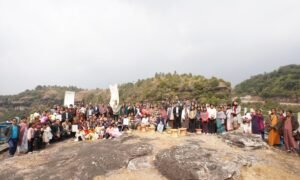
Gathering of the Agroecology Learning Circles in Laitsohpliah witnessed participation of communities, partners and supporters working towards strengthening Indigenous Peoples’ food systems in the region.
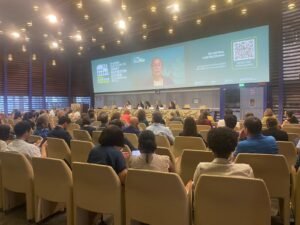
NESFAS and Laitsohpliah community hosted a special gathering of Agroecology Learning Circles (ALCs) on November 20, 2025 in Laitsohpliah, East Khasi Hills, to celebrate its recent distinction at the FAO World Food Forum in Rome. NESFAS’ pioneering ALC model was conferred the 2025 Global Innovation Award “When Farmers Lead Innovation! 2025 Innovation Award on Farmer Field School for Sustainable Agrifood Systems” on 16 October, a global recognition of community-led agroecology rooted in Indigenous knowledge systems.
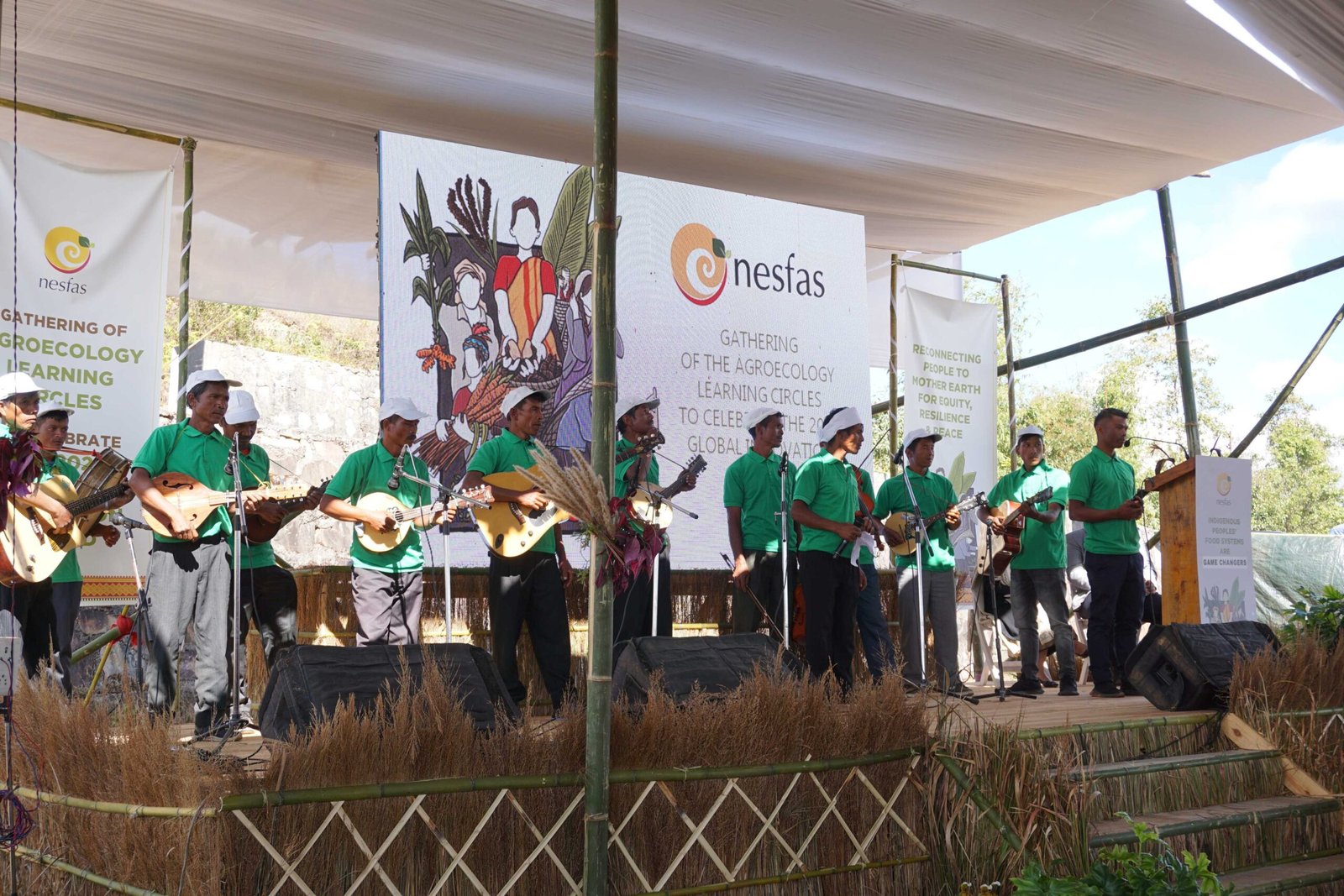
The gathering began with a procession into the village led by the Ki Sur Pynbang Band from Umsawwar, accompanied by community members and dignitaries in a symbolic display reflecting the shared spirit and unity of the gathering.
In his opening remarks, Mr. Wainsing Marwein, Sordar of Laitsohpliah, expressed gratitude to the Almighty and extended thanks to NESFAS for its guidance and to the community for their dedicated efforts in preparing for the event. A felicitation ceremony honoured five headmen from different communities for their leadership, and the gathering also remembered the contributions of a late ALC member by observing a solemn moment of silence.
Ms. Alethea Kordor Lyngdoh, Deputy Executive Director of NESFAS, delivered a short keynote address describing the award as a milestone for “over 600 partner communities across Meghalaya and Nagaland.” She emphasised that the award is not about NESFAS but a result of partnership and collective effort “that grew from a small idea into a movement that today inspires others around the world.”
Alethea highlighted the evolution of the ALC model from early inspiration during the International Terra Madre (ITM) 2015 to its adaptation from global farmer field school models into sovereign Indigenous learning spaces. Today, more than 100 ALCs engage over 2,000 members, 83% of whom are women and youth. The ALCs have mapped 210 landscapes, diversified school meals in 26 schools, and supported 21 community cooperatives. These outcomes, she said, demonstrate how “farmers have become teachers, experimenting, innovating, and reclaiming confidence in their food systems.” She followed her speech with a short video screening of the journey of ALC.
Following this, two community members belonging to different ALCs shared their experience of their journey. Mrs Wanpoiri Sumer, an ALC member of Lumtrep, shared how the platform has inspired farmers to continue traditional farming: “The ALC encourages us and teaches us how to sustain our indigenous practices,” she said. Mrs Jolina A. Sangma from Darechikgre expressed pride in representing her community, affirming that Indigenous knowledge continues to “protect our food systems and biodiversity.”
Thereafter, the gathering featured a cultural performance by Ki Sur Pynbang Bathiang from Umsawwar, followed by reflections from several distinguished speakers.
Mr. Carl O Rangad, Former Vice Chairman, Operations, NESFAS, credited community leadership and the contribution of women and youth for the award. He stressed that the ITM 2015 was a turning point that uplifted Indigenous identity and reminded attendees not to take natural resources for granted.
Mr. H.H Mohrmen, Former Chairperson NESFAS and president of SURE spoke on the resilience of traditional crops like millet and acknowledged NESFAS’ role in bringing Indigenous foods to global attention through platforms such as the Mei-Ramew Cafés. He praised the ALCs for pioneering work in Indigenous food systems and celebrated community-led conservation successes, including the safeguarding of the Umngot River.
Fr. Teibor Lyngdoh, Director SSC highlighted the synergy of scientific and Indigenous knowledge within ALCs: “Let us continue to build together and care for nature. We can leave the world a better place for our future generations,” he said, urging the communities to work on three Ps; to be proud, to promote, and to preserve their heritage.
Dr. Sushil Saigal, Executive Director of TNCC, noted that NESFAS’ initiatives embody the principle of “Think globally, Act locally,” describing the ALC ripple effects as pebbles in a lake impacting many layers of society while also reserving special praise for School Meals.
Mr. Nestar Kharmawphlang, Chairperson NESFAS and ALC member, said the award has captured global attention and added that ALCs should work harder and not rest on the laurel. He recounted insights gained from his recent participation at the EchoAsia Conference and reaffirmed the collective resolve to protect Mother Earth. Bah Nestar also presented a couplet with some of the community members.
Mr. M. Syiem, Syiem of Hima Sohra appreciated NESFAS’ global recognition and urged the state to carry the momentum forward, particularly in the tourism-dependent Sohra region.
Mr. Gavin M Mylliem, MLA of Sohra Constituency reflected on NESFAS’ journey since 2012, acknowledging the challenges NESFAS has had to face to uplift indigenous communities. He added that the award was a testament of NESFAS’s success and lauded NESFAS for encouraging youths and women to lead the way. He emphasised that farming must diversify, citing that people are now more health conscious and also touched on how millet, a once nearly forgotten crop has made a comeback. He also stated that communities should look beyond broom cultivation to sustain themselves.
Mr. Pius Ranee, Executive Director of NESFAS, expressed gratitude to the ALC members, partner organisations, and dignitaries. He reflected on how the movement grew from a single village to more than 100, and now influences over 600 communities across Meghalaya and Nagaland. He emphasised the importance of combining scientific tools with Indigenous knowledge, citing examples like insect life-cycle studies and soil-restoration experiments. He also highlighted the upcoming International Mei-Ramew Learning Centre at Laitsohpliah, which will serve as a global hub for Indigenous knowledge and agroecology exchange.
In his address, Mr. Phrang Roy, Coordinator TIP, and founding Chairperson of NESFAS reflected on the significance of the FAO Global Innovation Award, emphasising that the recognition belongs to the ALC members across 100 villages whose work blends Indigenous wisdom with scientific learning. He spoke candidly about lessons from past development models, ranging from cash-crop interventions to externally driven agricultural schemes that often led to ecological decline when detached from local knowledge. Contrasting this, he highlighted enduring Indigenous Peoples Food Systems and landscape stewardship, rooted in values of caring, sharing, and respect for Mother Earth.
Mr. Phrang Roy warned of the global environmental crisis driven by extractive industries and modern agriculture, noting the urgency of returning to nature-based systems. He concluded by stating that the ALCs are lighthouses showing pathways that communities, governments, churches, and traditional institutions can follow.
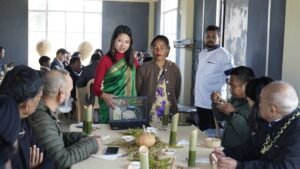
The celebration closed with a vote of thanks from Mr. Chenxiang R Marak to all partners, dignitaries, and community representatives who have contributed to the ALC movement and the commitment of the 100 ALC members in preserving traditional knowledge and biodiversity. The gathering also had a farmers market where members of different ALCs showcased and sold their produce and products.