In 2024, NESFAS, along with five partner villages from East Khasi Hills, Meghalaya, viz. Nongtraw, Dewlieh, Umsawwar, Ladmawphlang and Nongwah, launched the project “Demonstrate successful community-led management plan of degraded lands to conserve and manage wild biodiversity and Agrobiodiversity for local livelihoods security” under OP-7 of the GEF Small Grants Programme in India (SGP India) funded by the United Nations Development Programme.
On the surface, the project aimed to restore 200 hectares of degraded community land through reforestation using locally appropriate tree species, while also implementing improved land-management practices across an additional 175 hectares, including the management of jhum fallows. On a deeper level, the project drew on NESFAS’ Indigenous Peoples’ Biocentric Restoration approach of placing importance on the values of caring, sharing, reciprocity and respect for mother earth, and sought not only to restore damaged lands but also to rekindle the relationship between the indigenous communities and their biodiversity.
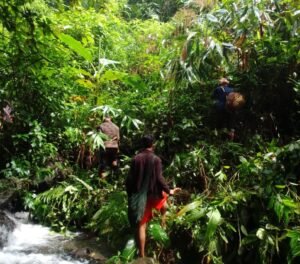
At the heart of this biocentric approach is the idea of “connecting the dots”—recognising that restoration does not happen in isolation, but within a living landscape. Guided by the traditional knowledge and observations of the communities, degraded restoration sites were therefore identified in proximity to existing forests, where local vegetation was already thriving. The communities understood that planting within these familiar ecological surroundings would give the saplings a stronger chance to establish and flourish. In this way, restoration became not just about planting trees, but about reconnecting degraded lands with the wider ecosystem and the knowledge of the people who have cared for it for generations.
Approaching the project from this perspective allowed the communities to design solutions that reflected their local needs and draw on their indigenous knowledge. The partner communities identified suitable plant species for their respective project areas with particular emphasis on their role in improving soil health, regulating water, and supporting pollination.
Technical training for setting up nurseries was provided to the communities. Interestingly, all the 5 communities took on the approach of decentralising their nurseries, directly allowing each household to set up their own household nurseries.
“From a governance perspective, the UNDP project has been an eye-opener for us. It has made us think about how to strengthen our rules and regulations to better protect our environment, and it has allowed us to consult with our elders on which tree species are most suitable for our village. This project truly focuses on traditional knowledge and practices,” said Sephrin Nongrum, former headman of Umsawwar.
Along with the restoration process, NESFAS also partnered with other funders in setting up community-based initiatives to conserve and manage wild biodiversity for local livelihoods security. This included activities such as linking wild agrobiodiversity to school meals, capacity building for the expansion and support for selected Mei-Ramew cafes and diversifying the home/kitchen gardens of the communities with wild edibles and fruit trees to increase the intake of locally sourced nutritious food among the communities.
Although it is difficult to objectively quantify the overall impact of the project after only two and a half years, many meaningful developments have been achieved in these communities since the project was implemented.
The project has strengthened community-led conservation and natural resource management through participatory mapping, documentation of local rules and customary restrictions, improved demarcation and signage, and helped raise greater awareness of community forests, restricted forests, fish spawning areas, and community-managed conservation areas. The diversification of their kitchen gardens with wild edibles and fruit trees has also helped reduce dependency on markets for fruits while giving communities the option to sell off excess produce for some extra income.
Sitamary Nongrum, a custodian farmer from Umsawwar, stated that the project went beyond environmental restoration and even helped support the livelihoods of the communities. “We are earning from the nursery we have raised, and I hope we can continue this initiative to further strengthen our traditional practices,” Sitamary added.
So far, one of the more meaningful impressions of the initiative has been the indelible mark it has left on the communities in how they view reforestation and ecological restoration as extremely important features of the safeguarding of their agrobiodiversities. The community members have become cognizant of the values of the restoration initiative and demonstrated a strong disposition to work collectively towards the restoration process.
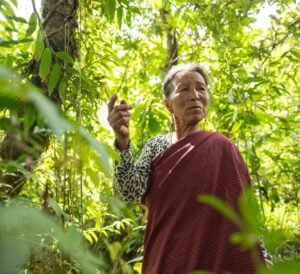
Community members from Umsawwar and Dewlieh shared how each member of the community has started taking responsibility for the restoration process, leading to a growing sense of ownership and community participation for the initiative. According to Pretty Dohling, a farmer from Dewlieh, there is also a newfound appreciation among the communities for local plant species which have always been neglected despite their resilience to changing climatic conditions and the role they play in maintaining ecological balance.
Within the two years, approximately 2,00,000 saplings of local species of trees procured from the community and household nurseries have been planted in the five communities, with monitoring data indicating an 80% survival rate and growth of the saplings. While the full ecological impact of the plantation drive will only become visible over time, the initial progress reflects the commitment of the communities and their willingness to collectively restore their biodiversity.
The project is also a testament to how ecological restoration among indigenous communities must be based on these communities drawing upon their traditional knowledge and participation in decision-making to bring about tangible changes. It also reinforces NESFAS’ belief in the Indigenous communities who have long been considered the true caretakers of their landscapes and biodiversity.