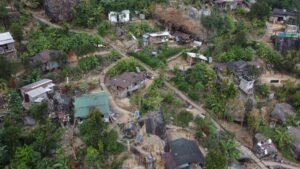
For a mother raising a child on her own, making ends meet can mean taking whatever work is available, even when the work is difficult and the earnings are uncertain. For years, this was the reality for Barida Kongngain, a school meals cook from Mawbri. As she raised her child, she took up whatever work she could find, often earning just enough to meet the family’s daily needs.
For a time, one of those livelihoods was making charcoal. It was physically demanding, requiring her to cut and prepare wood before she could produce the charcoal. As a woman, the work was particularly difficult, and she often had to hire people to help with the heavier tasks. Sometimes, what she earned from selling the charcoal was barely enough to cover the labour costs.
“It was not enough to make ends meet, especially with the rising cost of living nowadays,” she recalls.
Yet Barida had always hoped to find a livelihood that could provide her family with greater stability. She wanted to rear pigs, but the initial investment was beyond what she could afford. Whatever little she earned was usually spent on food and other daily necessities, leaving nothing to put towards purchasing piglets.
That changed when she received support from NESFAS under the LIC HFL’s CSR initiative. The support enabled her to purchase pigs and begin the livelihood she had wanted to pursue for years. For Barida, this was more than an opportunity to receive livestock. It meant being able to act on an aspiration that had remained out of reach for so long and to explore a source of income that she could build over time.
“I have finally been able to start pig rearing that I had always wanted to do,” she says.
But Barida’s story does not stop with the livelihood she is building at home. At St. Anthony’s LP School in Mawbri, she also works as a school meals cook. The school meals programme here is supported by the Indigenous Peoples Assistance Facility (IPAF) of the International Fund for Agricultural Development (UN IFAD) initiative implemented by NESFAS, and her role there carries a deeply personal connection; her child is a student at the school.
In the school kitchen, Barida helps prepare and serve a variety of delicious and nutritious meals for the children. Her daughter is among them, allowing her to see the value of the school meals programme not only through her work as a cook, but also through her experience as a mother.
“As a cook and a mother of a school-going child, I have seen how the support from NESFAS through the school meals programme has helped my daughter,” she explains. “There are many types of food that are provided at school which I am not able to provide for her at home.”
The experience has also broadened her own understanding of food and nutrition. Through her work as a cook and her engagement with NESFAS, she has gained greater knowledge of the importance of diverse and nutritious foods. What she prepares in the school kitchen is therefore more than a meal; it is part of ensuring that children have access to a wider variety of foods, including those that may not always be available at home.
Her circumstances have not changed overnight, and her income remains low. Yet, through her collaboration with NESFAS, she has been able to increase her income, gain knowledge about food and nutrition, and begin the pig-rearing livelihood she had long hoped for.
Today, she continues to prepare nutritious meals at St. Anthony’s LP School, where her own daughter is a student. From building a livelihood at home to nourishing children at school, she is taking steady steps towards a more secure future for her family.