Dewlieh, a small village hidden amid the backdrop of towering landscapes of Khatarshnong in East Khasi Hills, Meghalaya, has recently emerged as a model for community-led restoration and ecological stewardship. The community’s work on restoring the fragile ecological zone they inhabit and their Biodiversity Nursery, which produces saplings of native plant species, is leading the way in helping Meghalaya counter its alarming loss of forest cover.
In the early 2000s and 2010s, Dewlieh, like most of Meghalaya, experienced an alarming loss of forest cover. The community had watched the landscape surrounding them change as diverse forests rapidly gave way to broom grass plantations and extractive livelihood activities, contributing to a significant biodiversity loss in the area.
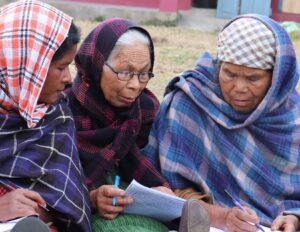
The turning point for Dewlieh began nearly a decade ago when NESFAS began working with the community’s farmers in 2015. The early focus was on reviving neglected crops such as millet, which were traditional staples once central to local diets and culture. Subsequently, the success of the early works led to the creation of the Dewlieh Agroecology Learning Circle (ALC) in 2018. The ALC provided a platform that brought elders, youth, and women together to share observations about the land, discuss seasonal changes, and re-learn the rhythms of nature.
Over time, the focus of work in Dewlieh progressed from reviving neglected crops to addressing the immediate need for land restoration. In 2021 and 2023, NESFAS, with support from FAO, implemented biocentric restoration efforts at Dewlieh to restore lands lost to broom plantations and extractive livelihoods. What stood out during this particular restoration effort was the use of native saplings rather than fast-growing non-native trees, which often harmed the biodiversity. Coincidentally, the restoration effort using locally valued species such as Diengsong (Erythrina arborescens) and Diengdoh (Pipli) saw a staggering 95% survival rate after plantation, largely surpassing other conventional afforestation methods.
Buoyed by the result of these efforts, the Dewlieh ALC formalised itself into the Dewlieh Primary Agroecology Cooperative Society in 2024, strengthening its organisational base and capacity to implement community-led initiatives. In the same year, during a co-design workshop under the “LIC HFL Special Project in East Khasi Hills and Ri Bhoi, Meghalaya” implemented by NESFAS, the cooperative passed a collective resolution to establish a biodiversity nursery:
“A Focus Group Discussion (FGD) was initially conducted, bringing together men and women to share their expertise on various tree propagation methods. As part of the initiative, women collected seeds from local gardens, fields, and forests, while youths took charge of planting and monitoring the trees,” shared Bah Shaiphar Dohling, community consultant, NESFAS, speaking about the initial stages of the community’s Biodiversity nursery.
The community members, through the biodiversity nursery, aimed to scale up the availability of native tree saplings for restoration, responding to the urgent need to regenerate degraded landscapes with ecologically appropriate species.
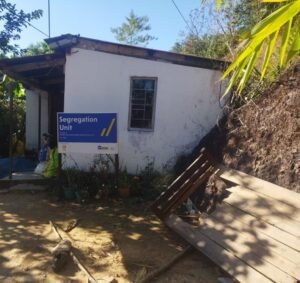
Eventually, the biodiversity nursery was established on community-owned land and built using locally available materials such as bamboo, straw, and reclaimed wood. Guided by community elders, priority native species were identified based on their ecological and cultural value, and community members were assigned responsibilities for seed and sapling collection, with seasonal calendars developed for optimal harvesting periods.
Today, the nursery stands as a converging point for learning, where traditional methods of composting and pest management are blended with scientific inputs from NESFAS and partner institutions. It aims to produce more than 30,000 saplings annually, prioritising native and multipurpose species that contribute to soil regeneration, water conservation, and pollinator habitats. These saplings, consisting mainly of 14 native tree species, are distributed for community-led plantation drives and shared with government and NGO partners engaged in ecological restoration.
Importantly, the nursery also generates livelihood opportunities, particularly for women and young people who take the lead in seed collection, nursery management, and transplanting:
“The nursery has become a pathway for those who have no means of earning an income to buy what they need. The benefits we’ve gained have opened opportunities for us to explore livelihoods, learn about local species, conservation and much more,” said Kong Jnget Diengdoh, a member of the Dewlieh Agroecology Cooperative Society.
However, amidst all the relative early success, the nursery still faces certain risks from unreliable native seed supply, limited funding, pest challenges, and weak stakeholder coordination. To address this, the community is currently exploring partnerships with government forestry programmes, external stakeholders and neighbouring villages to create a network of community nurseries. This, in turn, would help sustain the nursery while playing a vital role in helping Meghalaya counter its alarming loss of forest cover – estimated at 75 square kilometres a year.
Looking ahead, the Dewlieh Cooperative Society plans to expand the nursery’s scope to include medicinal and wild edible plants, connecting ecological restoration with nutrition and health. Programmes to link the nursery with local schools are in place to ensure children grow up understanding biodiversity not as an abstract idea but as a living practice. The school meal program aims to incorporate locally sourced ingredients into the PM POSHAN Meals scheme to enhance the daily dietary intake of nutritious food among school-going children.