Written by Aibaniengskhem Khongsit & Co written by Dahunika Rymbai and Etaduale Pame
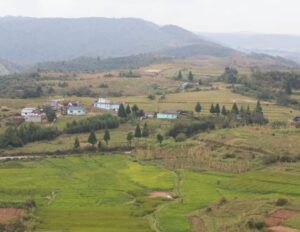
Hidden among the misty hills of Sohra lies Nongpriang Village, a place where time seems to walk slowly and nature still leads the way. Nongpriang is known as one of the twelve pedestrian villages, a village without roads. No vehicles disturb its silence, and no concrete paths divide its land. To reach this village, one must walk, step by step, through nature itself. This long walk is not a hardship for the people of Nongpriang but a way of life that connects them deeply to their surroundings.
During the rainy season, Nongpriang transforms into a breathtaking landscape. The valleys are covered in lush green trees, and clouds drift low across the hills, wrapping the village in a soft, cool mist. Waterfalls appear along the slopes, and the sound of flowing streams fills the air. The land looks alive, nourished by the rains on which the people depend for their livelihood. Every path, every stone, and every tree seems to tell a story of endurance and harmony.
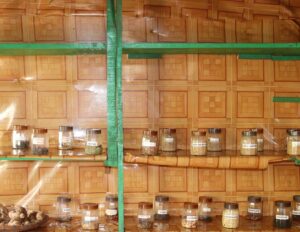
The people of Nongpriang live in areas such as Polo Ki Shang, where life is simple but meaningful. Agriculture is the backbone of the village. The villagers cultivate crops like synsar, kait, shriew, and many others. Farming here is not guided by machines or chemicals but by traditional knowledge passed down through generations. The soil is respected, and crops are grown using natural fertilizers taken from the environment. This organic way of farming reflects the villagers’ belief that the land must be cared for, not exploited.
One of the most remarkable aspects of life in Nongpriang is the journey the community members make to sell or exchange their produce. To reach Sohra, they must walk more than 4,000 steps, a journey of around one hour, carrying their goods on their backs. This journey is long and tiring, yet it is undertaken with patience and determination. Each step is a reminder of their strength and resilience. Despite the difficulty, the community members rarely complain, for they understand that this path sustains their families and preserves their way of life.
Alongside this living landscape exists the memory of Mawkaliar, an ancient village remembered only through stories. Elders speak of it as a once-thriving settlement now reclaimed by forest and silence. Though no houses remain, its name continues to live on in oral history, passed from one generation to the next. This neighbouring village, where people once lived, is now covered with thick trees and shrubs, as if nature has gently absorbed the village back into itself. Those who once belonged to Mawkaliar are believed to have moved to nearby villages, carrying fragments of memory with them. Mawkaliar stands as a reminder that while villages may disappear, stories endure. Through such memories, the people of Nongpriang remain connected to their past and to the land that shaped them.
Despite its beauty and strong traditions, life in Nongpriang is not without challenges. One of the greatest difficulties the community faces is isolation. Though Nongpriang may not seem far on a map, it often feels distant from the outside world. Roads leading toward the village are narrow and damaged, making access difficult. When someone falls ill at night, reaching a hospital becomes a race against time. As darkness falls, movement becomes unsafe, and the village is quickly enveloped in silence and shadow. Elders avoid stepping outside after sunset, and children once struggled to study as daylight faded.
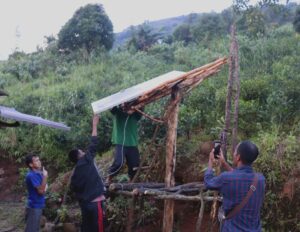
This reality began to change with the collaboration of NESFAS. Through its climate-resilient village programme, solar lights and solar systems were introduced to households and community spaces. For the first time, evenings in Nongpriang were no longer ruled by darkness. Children could read and study at night, families could cook, talk, and work longer, and village paths became safer. The gentle glow of solar light brought more than visibility; it brought dignity, security, and renewed hope.
Livelihood remains another daily struggle. Farming in Nongpriang depends heavily on rainfall, and when crops fail, families suffer deeply. There are a few alternative sources of income, and many young people feel compelled to leave the village in search of work elsewhere. This migration slowly weakens community bonds and places emotional and economic strain on families left behind.
Education, too, has long been a quiet struggle. Many parents in Nongpriang never had the opportunity to attend school. Some cannot read or write, and for years, education felt distant and uncertain. Children often missed school due to long distances, household responsibilities, or harsh weather conditions. Learning was easily interrupted, and continuing education felt fragile.
Yet change is slowly taking root. The community has begun to recognise the importance of education, even if earlier generations were denied it. With better lighting and growing awareness, children are now encouraged to study after sunset. It symbolizes a new beginning and the hope that future generations may not face the same barriers as their parents.
The path forward for Nongpriang does not depend on large outside interventions but on strengthening local skills, resources, and community-based efforts. Solar energy has already transformed daily life by reducing dependence on limited electricity and improving living conditions. Another important solution lies in bamboo craftwork. Bamboo is easily available, and people use traditional skills to make baskets, mats, tools, and household items. This craft provides an additional source of income while preserving indigenous knowledge and strengthening self-reliance.
Farming continues to remain central to village life, with solutions focused on improving practices rather than replacing them. Families grow crops mainly for their own consumption and local use, sometimes along with small livestock. Crop diversification and careful land management help reduce economic pressure and support food security.
Nongpriang teaches us the importance of remembering where we come from. It is not merely a village without roads; it is a village rich in culture, history, resilience, and wisdom. Its paths are made of earth, its stories carried in memory, and its future rooted in respect for nature. Through its struggles and solutions, Nongpriang reminds us that progress does not always mean moving forward with machines; it can also mean walking carefully, strengthening communities, and nurturing hope step by step.
This is not just the story of a village. It is a story of heritage, resilience, and faith, a story meant to be remembered.
This story has been documented and written by rural youth who are part of NESFAS’ Grassroots Journalism and Participatory Video Programme under its participatory storytelling initiative. Through their lived experiences, these young storytellers are shaping narratives for change and bringing forward community-led stories that reflect local voices, wisdom, and realities. Through their work, Indigenous Peoples’ Food Systems (IPFS) are highlighted not as distant concepts, but as living practices woven into everyday life, culture, and resilience of their communities.