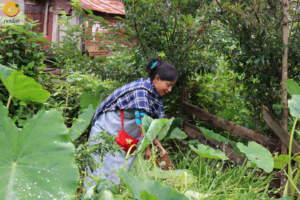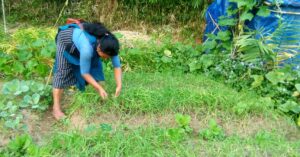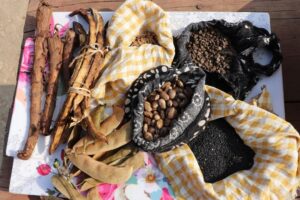
Tyniar, a small village in the Khatarshnong area under Laitkroh Block, is an indigenous community connected to the outside world only by footpaths. Despite the challenges of living without road access, the people of Tyniar, with a population of just 242 people, have remained deeply rooted in their natural surroundings, valuing the forests, rivers, and land that sustain them.
This community is one of the 210 indigenous communities in Meghalaya where NESFAS, in collaboration with The Nature Conservancy (TNC) and the Meghalaya State Biodiversity Board (MBB), partnered to upgrade the People’s Biodiversity Registers (PBR). The register is a document containing comprehensive information on local biodiversity, along with related traditional knowledge and practices of a particular area under a Biodiversity Management Committee (BMC).
The PBR highlighted Tyniar village’s rich biodiversity, traditional knowledge and sustainable practices such as shifting cultivation and sacred forest preservation.
Through gender-based discussions, the People’s Perspective Landscape Management Plan (PPLMP) was developed, and they identified key conservation targets. The community prioritised the pressing need to conserve and safeguard their two main water sources, namely Umthli and Wah Dymmiew.
Following that, the community planned interventions including planting water-conserving trees, banning tree cutting near water sources, constructing check dams and storage tanks, and strengthening community rules. These steps aim to protect water resources and ensure long-term sustainability.
On August 7, 2025, the Dorbar Shnong, in collaboration with NESFAS, initiated a tree plantation programme in the Umthli area.
The whole community participated in the plantation drive, and a total of 208 saplings were planted, viz. 126 saplings of Pipli (Diengdoh), 29 saplings of Alder (Diengliengiong), 5 saplings of Chinquapin (Diengsohot), 21 Acasia saplings, and 27 Sohmassar saplings. The saplings were provided with support from the Social Forestry Division, Sohra Range.
The community members selected these species for their ecological benefits. For example, Alder trees not only enrich the soil by fixing nitrogen but also help in improving water sources. Similarly, Chinquapin trees, which are suited for hilly terrain, play an important role in enhancing water availability in the area.
“It became clear to us that certain catchment areas needed more trees, and this understanding inspired us to take action, knowing that every tree planted contributes to a healthier environment and a more sustainable future,” stated Bah Donbok Sohkhlet, Headman of the Tyniar community, speaking on the tree plantation initiative.
This initiative demonstrates the community’s deep commitment to environmental stewardship and sustainable resource management, reflecting a broader aspect of how indigenous communities safeguard the environment and its resources.
“When we plant trees, we do it not only for ourselves but for our children and the generations to come. Trees give us shade, water, and clean air. They are truly a gift to the future. Today, our needs may be met, but what about tomorrow? That is why we must plant more trees, to safeguard our children and protect the future,” commented Aiborlang Khongsit, community member, taking pride in the plantation drive.
Community members continue to regularly visit the plantation site to monitor the growth of the trees, ensure they remain healthy, and maintain the surrounding area to keep it clean and well-maintained. By restoring green cover in vital catchment zones, the people of Tyniar hope to strengthen their forest resources and secure their drinking water sources and safeguard them for future generations.