We were in Umang Nongbah, Ri-Bhoi, to document a traditional hill paddy farming practice. The community in this village belongs to the Karbi Indigenous People group. I thought I was going there to capture a farming activity on video, but I came back with a much deeper understanding of what an Indigenous Peoples’ food system really is.
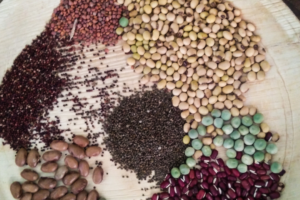
In the village, paddy is commonly grown in the lowland fields. But hill paddy cultivation, once a much more common practice, is now slowly disappearing. This year, only six households continued this tradition. They still sow local varieties of sticky rice and black sticky rice, seeds that have been passed down through generations and are valued for their quality and taste. As I stood there watching them work, I could not help but wonder what would happen if these six households were no longer able to carry the practice forward. It felt like I was witnessing not just the sowing of seeds, but the quiet preservation of a way of life.
The farming system itself is called shifting cultivation, but what touched me the most was a practice known as Sok rep ki nong. It simply means that community members come together to share their labour and help the family that is about to sow hill paddy. No one is hired. No one keeps count of the hours. People just show up because they know that one day, others will do the same for them.
The day began with a ritual called Ka suit ka shor. Here, the paternal head of the household sprinkled rice beer on the land, offering gratitude and seeking blessings before the work began. It was a simple act, but it reflected the respect they have for the land that feeds them.
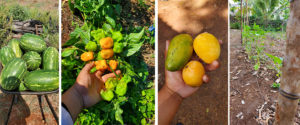
Then the father of the family walked up slowly across the hillside carrying a bamboo basket filled with seeds. It was not only rice that he was sowing. Seeds of roselle, black sesame and two types of local pumpkin were mixed with the rice. Watching him scatter these different seeds together points to one thing: biodiversity is not a concept written in reports. It is a living practice.
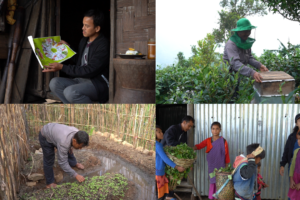
Behind him, about ten men slowly moved in a straight line, ploughing the field as they went up, while a few women followed behind, clearing weeds that had come up along the way. There was something unusual I noticed at this point. The women’s heads and faces were almost completely covered, with only their eyes visible, protecting themselves from the dust rising from the freshly turned earth.
Everyone had a role. Everyone contributed. There was no sense that one task was more important than another.
Since it was the weekend, the family’s children were also in the fields with us. They were not simply watching from the side. They were learning by doing and helping their parents in whatever way they could. I still remember the daughter, who looked to be around ten years old, making her way twice to a nearby spring to fetch water for everyone working in the field. It was a simple act, but it stayed with me.
Watching them, it became clear that these traditions are kept alive in small everyday moments. The children were not just lending a hand. They were learning the values of sharing, caring and living with the land that their parents and grandparents had learned before them.
By lunchtime, the hill had turned into a shared kitchen. The mother of the household had prepared a simple meal—pumpkin curry, chicken curry, chicken cooked with bamboo shoot, fresh local cucumber and local rice. The food was shared by everyone working in the field.
As we sat together for lunch, one elder kept everyone entertained with melodies from his Jangkek Muri. He played enthusiastically throughout the meal, filling the hillside with music and laughter. The Jangkek Muri is a traditional clarinet-like bamboo wind instrument used by the Karbi and Dimasa communities of Assam. In that moment, it felt as though the music was as much a part of the food system as the seeds, the land and the people themselves.
As I sat there eating, I could see that Indigenous food systems are not just about growing crops or foraging. They are guided by values of sharing and caring. People share seeds, labour, food, knowledge and responsibility. They care for the land because they know the land cares for them. They care for one another because survival has always depended on the community.
I also could not stop thinking about the fact that only six households continue this practice. If these traditions disappear, we will not only lose local rice varieties or farming techniques. We will lose a way of living that teaches us that food is not a commodity but a relationship.
We had gone there to document a beautiful farming practice. But what I witnessed was something much bigger. I witnessed a community reminding us that the strongest food systems are built not on competition, but on sharing and caring.
This story has been documented as part of the ongoing project, “Demonstrating Community-Based Initiatives for Healthy and Sustainable Food Systems”, supported by Indigenous Peoples Assistance Facility (IPAF) of UN-IFAD. The project aims to strengthen communities’ capacities to document their own stories and promote sustainable Indigenous practices and knowledge systems.