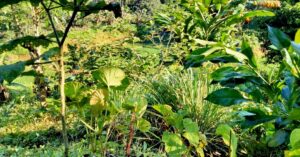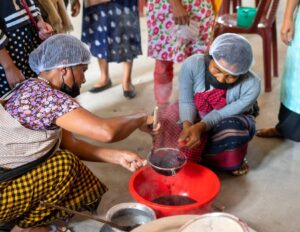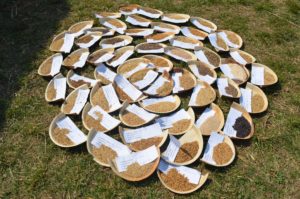
Nongpyrdi community in Mawkynrew Block undertook a banana sapling plantation to increase water levels and secure the water future.
Nongpyrdi is a small village located in Mawkynrew Block in East Khasi Hills of Meghalaya. The village has a population of just 463 people, and the community is largely agrarian, with most households growing common vegetables along with domesticated wild edibles in their kitchen gardens, such as Chameleon plant (Jamyrdoh) and Gynura (Jali). The community members are also largely engaged in betel leaf cultivation as a vital source for their livelihoods while also engaging in the cultivation of beans, taro, garlic chives, cucumber and chillies.
During the ongoing People’s Perspective Landscape Management Plan (PPLMP) session facilitated by NESFAS in July, 2025, the data presented included the list of natural resources available in the village, such as forests, water sources, farming systems, wild edibles, and other essential assets. The presentation of the data was carried out so that the community can better appreciate its natural wealth and develop plans for sustainable management and conservation, and take action accordingly.
The session also looked into prioritising the conservation of degraded or under-resourced ecosystems, including water, forest and other related resources in the community. During this session, it was brought to light that the water sources of the community were starting to degrade.
For the Nongpyrdi community, Wah Umsot has always been one of the main sources of water for drinking, washing, and other daily needs. However, in recent years, there has been an evident decline in the water levels, with the community facing water shortages in the winter months. It was observed that the riverside area was facing a decline in tree density, resulting in reduced vegetation cover, leading to a drop in water levels.
After thorough discussions among the community members, it was evident that immediate attention and action were required for their degrading water source, i.e. Wah Umsot. One of the initiatives proposed was the plantation of banana trees.
As such, on August 16, 2025, women community members, together with the Biodiversity Management Committee (BMC) members, took immediate action by planting 80 banana saplings along the riverbanks of Wah Umsot.
The banana saplings planted are native species locally known as kait rem and kait san, which also bear fruit and will serve a twofold purpose: to help restore the water levels of the Wah Umsot and to provide community members with fruit once matured. The BMC members, along with other community members, will conduct regular monitoring and visits to Wah Umsot to ensure their proper growth and post-plantation care.
“For the past few months, we have been working with the community, and they have demonstrated strong interest in our initiatives, especially through their commitment to collaborate in protecting the environment and managing resources sustainably for the future,” said Naphishisha Nongsiej, Associate, who is currently facilitating the initiative in the community.
The decrease in the water levels of the Wah Umsot can also be attributed to the increase in population in recent years, which has, in turn, affected the forest cover. The need to cut trees to expand areas for shifting cultivation to support the population may have indirectly led to the loss of forest cover, and it remains a prominent problem.
Teilang Nongrum, Headman, Nongpyrdi, “Through the discussions and mutual understanding with the community members, and under the guidance of NESFAS, we decided to plant banana trees along the riverbank. I have observed that many of these trees are growing well, and we have also agreed to continue following up on this initiative and to take good care of them.”
Since most of the lands are privately owned, there is no decree against cutting trees for expansion or shifting cultivation. However, the community, along with NESFAS, are currently making an effort to engage with landowners to ensure the preservation of trees along the riverside in order to secure the water future of the community.